Why I Choose IPTV 4K for the Best Viewing Experience
August 21, 2026
As a dedicated viewer, I have found that choosing IPTV 4K offers an unparalleled viewing experience. The combination of stunning picture quality, an extensive range of channels, and remarkable value makes it my top choice in the United Kingdom. Transitioning from a traditional cable subscription, I was astonished to discover that for a fraction of the cost, I could access over 20,000 live channels and 100,000 on-demand movies and series.
With more than 56% of smart TVs now supporting 4K, many households are equipped to enjoy this superior quality. Yet, many still rely on outdated broadcasting methods that fail to deliver the full potential of their devices. Furthermore, with 85% of new content produced in UHD quality, investing in an IPTV 4K service is not merely a step towards future-proofing; it’s about maximising the capabilities of the technology already at hand.
In this guide, I will explore what IPTV 4K truly is, how it surpasses traditional television, and what features to look for in a subscription plan. I will also share insights from my personal experiences with various services and devices, ensuring that you can achieve a seamless, buffer-free streaming experience.
Understanding IPTV 4K: What It Is and How It Works
The transition to IPTV 4K represents a significant leap in how we experience television today. IPTV, or Internet Protocol Television, is a modern method of delivering live TV channels and on-demand content via a broadband internet connection. This innovative approach replaces traditional terrestrial aerials, satellite dishes, and coaxial cable infrastructure.
As we look towards 2026, IPTV 4K encompasses more than just a resolution upgrade to 3840 x 2160 pixels. It integrates high dynamic range formats such as HDR10, HDR10+, and Dolby Vision. These technologies ensure high-bitrate streaming that maintains fine detail, colour accuracy, and motion clarity.
To understand how IPTV delivers content over the internet, we must consider the technical pipeline involved. Video is encoded using advanced codecs like H.265/HEVC or AV1 for 4K streams. The data is segmented into small packets and transmitted through content delivery networks. Finally, it reaches the end user’s IPTV player, where hardware-accelerated decoding reconstructs the signal for display.
It’s a common misconception that IPTV is illegal. In reality, the technology itself is fully lawful in the United Kingdom. The crucial factor is the licensing status of the content provider. Reputable services, such as StreamIPTV4K, operate as legitimate content aggregation platforms, equipped with proper infrastructure.
When selecting a quality IPTV 4K service, consider these three essential components:
- High-bitrate servers: These should be located geographically close to UK users to minimise latency.
- Comprehensive channel lineup: A good service should offer a wide range of channels, including terrestrial, sports, films, kids, and international content.
- Responsive customer support: This is vital for resolving any issues that may arise.
For optimal streaming, a stable internet connection of just 10 Mbps is sufficient for HD content, while 20-25 Mbps is recommended for reliable 4K UHD delivery. Modern IPTV platforms utilise adaptive bitrate technology, which automatically adjusts stream quality based on bandwidth fluctuations. This feature prevents buffering during peak viewing hours.
Another key aspect is anti-freeze technology, which sets premium IPTV providers apart from budget alternatives. This technology dynamically manages stream delivery, ensuring smooth playback even during high-traffic events, such as Premier League weekends or Champions League nights.
In conclusion, understanding the technology behind IPTV 4K empowers UK consumers to make informed purchasing decisions. This knowledge helps avoid being swayed by marketing claims that often overpromise and underdeliver.
| Feature | Description |
|---|---|
| Technology | Internet Protocol Television (IPTV) |
| Resolution | 3840 x 2160 pixels with HDR support |
| Minimum Internet Speed | 10 Mbps for HD, 20-25 Mbps for 4K |
| Key Components | High-bitrate servers, extensive channel lineup, responsive support |
| Legal Status | Fully legal in the UK with proper licensing |
The Advantages of IPTV 4K over Traditional Television
Switching to IPTV 4K has opened up a world of viewing possibilities that traditional television simply cannot match. The financial implications of this choice are staggering. The average UK household currently pays between £80 and £110 per month for a traditional pay TV bundle. This equates to over £1,500 annually, a figure that has risen by 53% over the past decade, while the actual content offering has barely expanded beyond 300 channels.
In stark contrast, a premium IPTV subscription in the United Kingdom, such as StreamIPTV4K, can cost as little as £45 for a 12-month plan. This breaks down to approximately £5 per month, offering over 20,000 live channels and 100,000+ on-demand movies and series. With no additional equipment rental fees, no engineer installation charges, and no lengthy contracts, the financial advantages are clear.
Another key benefit I appreciate is the flexibility that IPTV 4K subscriptions provide. Unlike traditional services, which often bind you to lengthy contracts, these subscriptions operate on a month-to-month basis. This means I can adjust my plan, pause service, or switch providers without the hassle of dealing with retention departments.
The content disparity is staggering. While traditional pay TV offers roughly 250-300 channels of predominantly local content, a quality IPTV 4K service provides access to channels from over 150 countries. This includes live sports, news, documentaries, kids’ programming, and dedicated 4K movie channels that simply do not exist on legacy platforms.
Moreover, the on-demand content libraries available on IPTV 4K platforms dwarf anything offered by traditional television’s catch-up services. With over 100,000 titles, including new film releases and complete series box sets, the variety is immense. Pay-per-view events that would cost extra on cable are included in the standard IPTV subscription.
Multi-device flexibility is another advantage that traditional television cannot match. While a cable subscription typically restricts viewing to a single set-top box in one room, an IPTV 4K subscription allows simultaneous streaming on multiple devices. Whether it’s Smart TVs, Firesticks, Android boxes, smartphones, tablets, or computers, I can enjoy my favourite content at home or while travelling.
IPTV 4K services also eliminate hidden costs that inflate traditional TV bills. Charges for HD and 4K, sports package premiums, multi-room fees, and equipment rental can add £20-£30 to a monthly cable invoice before any content is actually watched. This transparency in pricing is refreshing.
In conclusion, switching to IPTV 4K is not merely a cost-cutting exercise; it represents a wholesale upgrade in viewing quality, content variety, and personal control over how, when, and where I consume television.
| Feature | Traditional Pay TV | IPTV 4K |
|---|---|---|
| Monthly Cost | £80 – £110 | £5 (12-month plan) |
| Channel Count | 300 | 20,000+ |
| On-Demand Titles | Limited | 100,000+ |
| Contract Length | 18 months | Month-to-month |
| Device Flexibility | Single set-top box | Multiple devices |
How IPTV 4K Enhances Your Viewing Experience
The evolution of viewing technology has transformed how I enjoy my favourite shows. One crucial aspect of this transformation is the integration of high dynamic range (HDR) technologies, which significantly elevate the overall quality of the viewing experience.
True 4K HDR Technologies: HDR10, HDR10+, and Dolby Vision
Resolution is only half the story. A 4K stream without HDR appears noticeably flatter than what a modern television can display. HDR technology enhances picture quality, providing depth in dark scenes and vibrant highlights. It ensures colour saturation that reflects how content was originally graded in post-production.
Three key HDR formats are vital for IPTV 4K in 2026:
- HDR10: The baseline open standard present in 67% of UHD TVs sold globally.
- HDR10+: This format adds dynamic metadata, allowing for scene-by-scene optimisation.
- Dolby Vision: Supports 12-bit colour depth and peak brightness of up to 10,000 nits, providing a cinematic home viewing experience.
It is essential to choose an IPTV player that supports these HDR formats. Ignoring HDR metadata can waste the investment made in a quality 4K television. IPTV One stands out as the only major player with native Dolby Vision support across eight platforms, including Android and iOS.
The Importance of Hardware-Accelerated Decoding
Another critical factor in enhancing streaming quality is hardware-accelerated decoding. Many IPTV players rely on software decoding, placing the burden on the CPU. This can lead to high CPU usage, dropped frames, and overheating, particularly on mobile devices.
In contrast, hardware acceleration offloads decoding to the GPU’s dedicated video decode engine. For example, on macOS and iOS, this uses Apple’s VideoToolbox framework, while Windows leverages DXVA2 and D3D11VA. My testing on an M2 MacBook showed that IPTV One could play a 4K HDR10+ stream at a consistent 60fps with minimal CPU usage.
Zero Buffering and High Uptime Streaming
Buffering can ruin the viewing experience. Achieving zero-buffering performance requires three elements working in concert:
- High-bitrate servers: Located close to UK users to minimise latency.
- Anti-freeze technology: This dynamically adjusts stream quality in real-time if bandwidth fluctuates.
- Proven uptime record: StreamIPTV4K delivers an impressive 99.9% uptime, even during peak viewing times.
Real 4K streams run at bitrates exceeding 18 Mbps. A player that cannot efficiently decode these bitrates through hardware acceleration will lead to buffering or downscaled output. Thus, viewers may miss out on the true quality they are paying for.
In conclusion, the combination of full HDR format support, hardware-accelerated decoding, and robust streaming infrastructure distinguishes a genuine IPTV 4K experience from services that merely claim 4K compatibility while delivering sub-optimal picture quality.
| Feature | Description |
|---|---|
| HDR Formats | HDR10, HDR10+, Dolby Vision |
| Hardware Decoding | Utilises GPU for efficient playback |
| Uptime | 99.9% uptime with anti-freeze technology |
| Bitrate Requirements | Exceeds 18 Mbps for real 4K streams |
| Player Support | IPTV One supports Dolby Vision across eight platforms |
Choosing the Best IPTV 4K Subscription Plan in the United Kingdom
Navigating the world of subscription plans is a pivotal decision for anyone looking to enhance their viewing experience. The right choice can make all the difference in how you enjoy your favourite shows and sports events. With a plethora of options available, it’s essential to evaluate the features and pricing of various services.
Overview of UK IPTV 4K Plans and Pricing
In 2026, StreamIPTV4K offers several competitive subscription tiers that cater to different viewing needs:
| Plan Type | Price | Monthly Cost | Connections | Key Features |
|---|---|---|---|---|
| 3-Month Starter | £19.99 | £9.33 | 2 | Full HD/4K quality |
| 6-Month Premium | £29.99 | £7.50 | 3 | Anti-freeze technology, 24/7 WhatsApp support |
| 12-Month Pro | £45.00 | £5.00 | 4 | VIP priority support |
| Lifetime Ultimate | £350.00 | One-time | 5 | All future updates included |
These plans include access to over 20,000 live channels, 4K Ultra HD quality, a vast video-on-demand library, electronic programme guide (EPG), and catch-up TV. In comparison, traditional UK pay TV subscriptions cost between £80 and £110 per month for around 300 channels. Thus, even the highest-tier IPTV option pays for itself within just a few months.
Key Features to Look For: Channels, Sports, VOD, and Support
When evaluating an IPTV subscription, consider the following essential features:
- Channel Variety: A premium service should offer over 20,000 channels, including UK terrestrial, international channels, and dedicated sports coverage.
- Sports Coverage: Ensure the service provides comprehensive access to live sports, including the Premier League, Champions League, and more.
- On-Demand Content: Look for a sizeable VOD library that includes the latest movies and series.
- Electronic Programme Guide (EPG): A quality EPG should provide easy navigation and catch-up functionality spanning up to 7 days.
- Customer Support: Opt for providers that offer 24/7 support via WhatsApp and email, ensuring quick resolution of any issues.
Additionally, consider the number of simultaneous connections allowed and whether the service includes anti-freeze technology to enhance streaming quality during peak times.
In conclusion, I recommend starting with a free trial or a short-term plan to assess the service’s quality before committing to a longer subscription. This approach allows you to verify the channel lineup, stream stability, and support responsiveness, ensuring that your chosen provider meets your expectations.
Essential IPTV 4K Compatible Devices
In today’s digital age, understanding the devices that support IPTV 4K is essential for an enhanced viewing experience. Fortunately, most households in the UK already own at least one compatible device. From premium Smart TVs to affordable streaming sticks, the options are vast.
Most modern Smart TVs, including brands like Samsung, LG, and Sony, are equipped to handle IPTV 4K. Notably, many 2020-and-later models run operating systems such as Tizen, webOS, or Google TV, which support native IPTV player apps. With 72% of flat-panel TVs above 50 inches now 4K-enabled, the necessary display hardware is already in place in many UK living rooms.
Smart TVs, Firestick, Android Boxes, and Other Devices
The Amazon Fire TV Stick range stands out as the most cost-effective entry point for IPTV 4K in the UK. The Fire TV Stick 4K Max features dedicated hardware video decoding, along with Dolby Vision and HDR10+ passthrough. Its compact design plugs discreetly into any HDMI port, and setup takes under five minutes using M3U links or Xtream Codes.
For power users, Android TV boxes like the NVIDIA Shield TV Pro offer unparalleled processing capabilities and AI-upscaling. More affordable alternatives, such as the Xiaomi Mi Box S and Chromecast with Google TV, still deliver excellent 4K IPTV performance at a fraction of the price.
Apple TV compatibility is also noteworthy. While the Apple TV 4K is a premium streaming device with outstanding picture processing, it requires an IPTV player that supports the platform natively. IPTV One is the only major player that delivers full 4K HDR with Dolby Vision on Apple TV, making it an essential companion app for Apple ecosystem users.
Smartphones, tablets, Windows PCs, and Mac computers can also serve as capable IPTV 4K clients. However, mobile devices greatly benefit from hardware-accelerated decoding to prevent battery drain and overheating during extended viewing sessions.
Recommended IPTV Players for Optimal 4K Streaming
The choice of IPTV player software is just as crucial as the hardware it runs on. A poor player may strip HDR metadata, rely on inefficient software decoding, and introduce buffering, even on a fast connection. A quality player like IPTV One leverages the device’s native hardware decoder for smooth, efficient 4K playback.
Here’s a comparative assessment of the leading IPTV players in 2026:
| Player | Supported Features | Compatibility |
|---|---|---|
| IPTV One | Full HDR10, HDR10+, Dolby Vision | 8 platforms |
| TiviMate | 4K resolution, limited HDR | Android TV only |
| IPTV Smarters | Basic 4K support, no HDR | Various devices |
In conclusion, matching your IPTV player choice to your primary viewing device is vital. Firestick and Android TV users who prioritise picture quality should opt for IPTV One, while those who prefer a traditional cable-like EPG interface might lean towards TiviMate, accepting the trade-off in HDR performance.
Setting Up Your IPTV 4K Service – A Simple Step-by-Step Guide
Setting up your IPTV 4K service is a straightforward process that anyone can master. Many first-time users worry about the technicalities involved, but the entire setup—from receiving your login credentials to watching live 4K content—typically takes under five minutes. Best of all, you don’t need any technical expertise or prior experience with streaming technology.
After selecting and paying for your IPTV 4K subscription plan, you will receive an M3U playlist link and Xtream Codes (a server URL, username, and password) via email and WhatsApp. These credentials are essential as they unlock the entire channel library, so it’s important to keep them secure.
For Amazon Fire TV Stick users, which is the most common IPTV 4K device in the UK, the setup process is as follows:
- Navigate to the Amazon Appstore.
- Search for your chosen IPTV player, such as IPTV One, TiviMate, or IPTV Smarters.
- Download and install the application.
- Open the app, select “Add Playlist” or “Add Provider,” and either paste the M3U link or enter the Xtream Codes into the appropriate fields.
Smart TV users will find the process nearly identical. Simply download the IPTV player app from your TV’s app store (Samsung Smart Hub, LG Content Store, or Google Play on Android TV), launch it, and enter the provided credentials. The entire channel list will populate automatically within a minute or two.
For those using Android boxes, such as the NVIDIA Shield or Xiaomi Mi Box, the same Google Play Store access applies. You can sideload APK files for players not available in the official store, but it’s advisable to stick with store-listed applications for automatic updates and security.
Apple TV and iOS users can download IPTV One directly from the App Store. This player offers the most complete 4K HDR experience on Apple hardware, with setup following the same credential-entry pattern as other platforms.
After the initial setup, it’s crucial to configure the IPTV player settings. Enable hardware acceleration in the player’s settings menu (set to “Auto” or “Hardware” rather than “Software”). Adjust the buffer size to 8-16 MB for high-bitrate 4K streams, and organise your favourite channels into custom groups for quick access to frequently watched content.
Reputable UK IPTV 4K providers like StreamIPTV4K include comprehensive setup guides with their welcome emails. They also offer 24/7 WhatsApp support with response times under two minutes. This means any setup hurdle can be resolved almost instantly by sending a message rather than struggling alone.
In conclusion, the one-time setup investment of five minutes unlocks years of buffer-free 4K streaming across every screen in your household. The process is intentionally designed to be accessible to users of all technical ability levels.
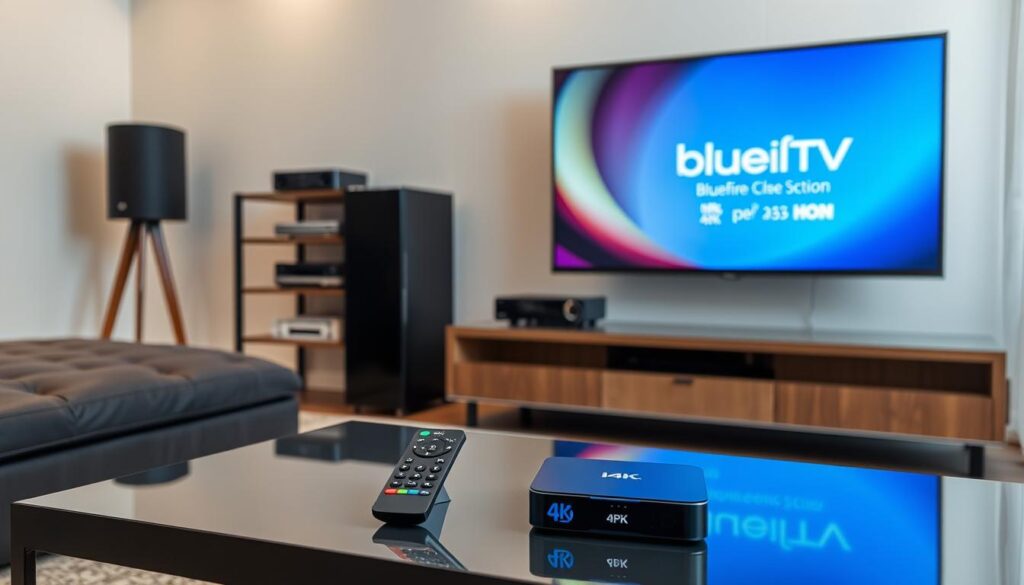
Internet Speed and Technical Requirements for Seamless 4K Streaming
The foundation of an exceptional streaming experience lies in the quality of your internet connection. To truly enjoy the benefits of 4K streaming, it’s essential to understand the specific bandwidth requirements that ensure a smooth experience.
Minimum and Recommended Bandwidth
When it comes to streaming, the minimum technical requirement for 4K content is 25 Mbps. However, for 4K HDR streams, such as those using HDR10+ or Dolby Vision, where bitrates often exceed 18 Mbps, a connection of 35 Mbps or more is recommended. This additional bandwidth provides the necessary headroom to prevent buffering during peak usage times.
Here’s a clear hierarchy of bandwidth requirements:
- Standard Definition (SD): Requires a minimum of 3 Mbps.
- HD 1080p: Needs at least 10 Mbps.
- 4K UHD (2160p): Demands a minimum of 25 Mbps.
- 4K HDR: Recommended connection of 35 Mbps or higher.
It’s important to note that these figures represent dedicated bandwidth for the IPTV stream alone. Any other devices on the network—like smartphones updating apps or laptops downloading files—will consume additional bandwidth. Therefore, if multiple users are active, targeting 50 Mbps or higher is advisable for uninterrupted 4K streaming.
Connectivity Tips: Ethernet vs Wi-Fi
Choosing between Ethernet and Wi-Fi connectivity is crucial for optimal performance. A wired Ethernet connection is strongly preferred for 4K streaming. This is because even the fastest Wi-Fi networks can introduce latency jitter and packet loss, leading to micro-stutters or frame drops during high-bitrate playback.
If Ethernet isn’t feasible, consider these tips for Wi-Fi:
- Use a 5 GHz network instead of the congested 2.4 GHz band.
- Position the router as close to the streaming device as possible.
- Consider using powerline Ethernet adapters or mesh Wi-Fi systems for better performance.
Adaptive bitrate streaming and anti-freeze technology also play a role in managing bandwidth fluctuations. Premium services dynamically adjust stream quality in real-time if the connection temporarily degrades, helping to prevent the dreaded spinning buffer wheel. However, this technology should be viewed as a safety net, not a substitute for adequate baseline internet speed.
I recommend testing your actual internet speed using tools like fast.com or speedtest.net. Testing during your typical viewing hours is crucial, as evening peak times often yield lower speeds than advertised. If your connection consistently falls below the 25 Mbps minimum for 4K UHD, consider contacting your internet service provider about upgrading to a fibre-to-the-premises package.
In conclusion, the United Kingdom’s broadband infrastructure has improved significantly, with many urban and suburban households now having access to fibre connections exceeding 50 Mbps. For most UK viewers, meeting the technical requirements for 4K streaming is simply a matter of configuring their home network correctly.
Customer Support and Reliability: Why It Matters for IPTV 4K Users
The quality of customer support and service reliability can make or break the enjoyment of an IPTV subscription. These factors are often more significant than mere channel counts or marketing claims when evaluating providers in the United Kingdom.
The IPTV landscape in 2026 features both premium providers who invest in robust infrastructure and support, and budget operators who resell oversubscribed servers with little to no customer service. The difference between these types becomes painfully clear during high-traffic events, such as Premier League matches or Champions League finals, when inferior services struggle to meet demand.
What genuine 24/7 customer support looks like can be exemplified by StreamIPTV4K. Their real human agents—rather than chatbots—respond via WhatsApp in under two minutes, offering assistance in English, French, and Arabic. They can resolve technical setup questions, billing inquiries, and stream quality issues on the spot, rather than escalating them to an unreachable “technical team.”
Support responsiveness is critical during unexpected moments—like a channel going dark just before kick-off, a playlist failing to load on a new device, or an urgent billing question. Providers who offer only email support with 24-hour response times leave their users stranded when they need help the most.
Reliability metrics define a premium IPTV service. A 99.9% uptime rate, backed by redundant server infrastructure, ensures that users can rely on their service. Additionally, anti-freeze technology dynamically manages stream delivery during peak traffic, while high-bitrate servers are strategically located close to UK users to minimise latency. These technical investments remain invisible until they are absent, at which point the viewing experience can collapse.
A clear refund and guarantee policy is also essential. Reputable UK IPTV providers offer a money-back guarantee if persistent technical issues cannot be resolved within 48 hours. This commitment reflects confidence in their infrastructure and provides users with financial protection that budget providers typically lack.
Comparing the support experience of premium IPTV services with traditional pay TV reveals a stark contrast. Traditional customer service often involves phone queues, engineer appointment windows, and offshore call centres. In contrast, the WhatsApp-based, instant-response support model of the best IPTV providers represents a genuine upgrade in customer care.
I recommend testing a provider’s support responsiveness during the free trial period. By deliberately sending a question via WhatsApp or email and timing the response, you can gauge the service’s long-term reliability more effectively than relying on marketing testimonials or review site ratings.
In conclusion, in the IPTV market, the cheapest subscription is rarely the best value. Paying slightly more for a provider with proven uptime, anti-freeze technology, and responsive 24/7 support ensures a viewing experience that is consistently enjoyable rather than intermittently frustrating.
| Feature | Description |
|---|---|
| Customer Support | 24/7 WhatsApp support with real human agents |
| Uptime | 99.9% uptime with redundant server infrastructure |
| Anti-Freeze Technology | Dynamically manages stream delivery during peak traffic |
| Response Time | Under 2 minutes for support queries |
| Refund Policy | Full refund if issues are unresolved within 48 hours |
Conclusion: Why I Choose IPTV 4K for the Ultimate Viewing Experience
Why do I choose IPTV 4K? The answer is clear: it combines superior picture quality, an extensive array of channels, and genuine cost savings in a way that traditional television simply cannot match.
Switching from conventional pay TV to a premium IPTV subscription can save the average UK household up to £1,200 annually. With access to over 20,000 live channels and more than 100,000 on-demand movies, the value is undeniable.
Moreover, as over 56% of smart TVs are now 4K-enabled, continuing to watch compressed HD broadcasts is a waste of your investment. IPTV 4K unlocks the full potential of your display.
With over 500 sports channels, including dedicated servers for major events, the experience is unparalleled. You can enjoy all your favourite sports in stunning detail without the dreaded buffering.
IPTV 4K also offers flexibility, allowing you to watch on any device, whether at home or on the go. The barrier to entry is low, with free trials available, so you can experience the service risk-free.
In conclusion, I refuse to pay over £1,500 a year for limited content when a superior alternative exists. I encourage you to claim your free trial and discover why millions have made the switch.
FAQ
What is IPTV and how does it work?
What benefits does IPTV offer compared to traditional TV?
How can I ensure the best streaming quality with IPTV?
What devices are compatible with IPTV services?
How do I set up my IPTV service?
What internet speed do I need for 4K streaming?
Why is customer support important for IPTV users?
Written by Jack Sullivan
Jack has worked with smart TV platforms and set-top boxes for several years, helping readers pick the right hardware for their setup. His writing leans practical, comparing real-world performance rather than spec sheets.